
As cloud computing, artificial intelligence, and digital infrastructure expand, data centers need dependable backup power to maintain critical operations. Alternators are essential components of data center generators, converting mechanical energy into electricity while influencing voltage stability and system reliability.
Choosing the right manufacturer therefore requires careful technical evaluation. This guide compares five manufacturers based on documented capabilities, technical specifications, engineering support, and suitable applications.
Key Takeaways
l Alternator performance is critical to data center reliability. Voltage stability, nonlinear load handling, transient response, and parallel operation are key factors when selecting alternators for data center generators.
l Different manufacturers serve different project needs. EvoTec Power, STAMFORD | AvK, Nidec Power, Mecc Alte, and ABB offer distinct strengths in voltage configurations, electrical performance, customization, and technical support.
l EvoTec Power is a potential choice for high-voltage data center projects. Its alternator portfolio and documented 10.5 kV data center projects make it worth considering for large-scale and customized backup power systems.
Data center backup power systems must support sensitive equipment, substantial electrical loads, and demanding availability requirements. The following characteristics help determine whether an alternator is suitable.
Stable voltage is essential for reliable power distribution. An automatic voltage regulator (AVR) adjusts alternator excitation to maintain output voltage as operating conditions change. Engineers should compare steady-state voltage accuracy, AVR response, and excitation performance rather than relying only on rated power.
Uninterruptible power supply (UPS) systems and power electronic equipment can introduce harmonic currents and challenging load characteristics. Alternators intended for generators for data centers should be evaluated for nonlinear load compatibility, winding design, reactance, and thermal performance under the project's actual load profile.
Sudden load additions or removals can cause temporary voltage deviations. Effective transient response helps a generator recover toward its specified operating voltage. Performance should be assessed using manufacturer load-step data and coordinated testing of the engine, alternator, AVR, and control system.
Alternator efficiency affects electrical losses and heat generation. Cooling arrangements, insulation systems, ventilation, and allowable temperature rise influence operating performance and equipment durability.
Alternators offer various power ratings and voltage options, including medium- and high-voltage configurations for larger data centers. Selection should match the facility's power demand, distribution system, and protection requirements.
Many data centers use multiple generator sets to provide redundancy and additional capacity. Alternator selection must therefore consider synchronization, reactive load sharing, excitation coordination, and compatibility with parallel operation.
The following manufacturers offer relevant solutions for critical power applications.
This comparison is based on publicly available manufacturer information, not an independently verified ranking of market share, reliability, or overall product quality.
|
Manufacturer |
Key Characteristics |
Suitable Applications |
|
EvoTec Power |
High-voltage alternators, documented 10.5 kV projects, nonlinear load capabilities |
Large data centers, high-voltage backup systems, customized projects |
|
STAMFORD | AvK |
Broad capacity range, wire-wound and bar-wound technologies, global service network |
Large facilities, critical standby power, varied generator capacities |
|
Nidec Power |
Data center pro solutions, low subtransient reactance, engineered configurations |
Complex electrical loads, specialized installations |
|
Mecc Alte |
Digital AVR, MAUX excitation, low-reactance design, maintenance accessibility |
UPS-intensive facilities, nonlinear loads, industrial backup systems |
|
ABB |
NMG critical-power series, compact design, 10.5–11 kV ratings |
Medium- and high-voltage installations, space-constrained facilities |
EvoTec Power is a Chinese manufacturer specializing in synchronous alternators for industrial, high-voltage, marine, and customized power generation applications.
Its data center solutions emphasize high-voltage output, nonlinear load capability, efficient operation, and performance in parallel or grid-connected systems.
Core Advantages
l High-voltage capability: The EVO638 high-voltage series supports voltage configurations up to 15,000 V, with 50/60 Hz operation and 4-, 6-, 8-, or 10-pole options. Specific voltage ratings should be confirmed during model selection.
l Documented project experience: EvoTec lists a Guizhou data center delivery involving four 1,800 kW, 10.5 kV generators and a Yan'an cloud computing project involving seven 1,800 kW, 10.5 kV generators.
l Nonlinear load performance: The company highlights its alternators' capability to accommodate large nonlinear loads and their dynamic performance during parallel operation.
l Engineering flexibility: High-voltage products and customized alternator offerings provide potential options for projects requiring specific electrical or mechanical configurations.
Best For: Large data centers requiring high-voltage alternators, customized generator solutions, and proven project experience with 10.5 kV power systems.
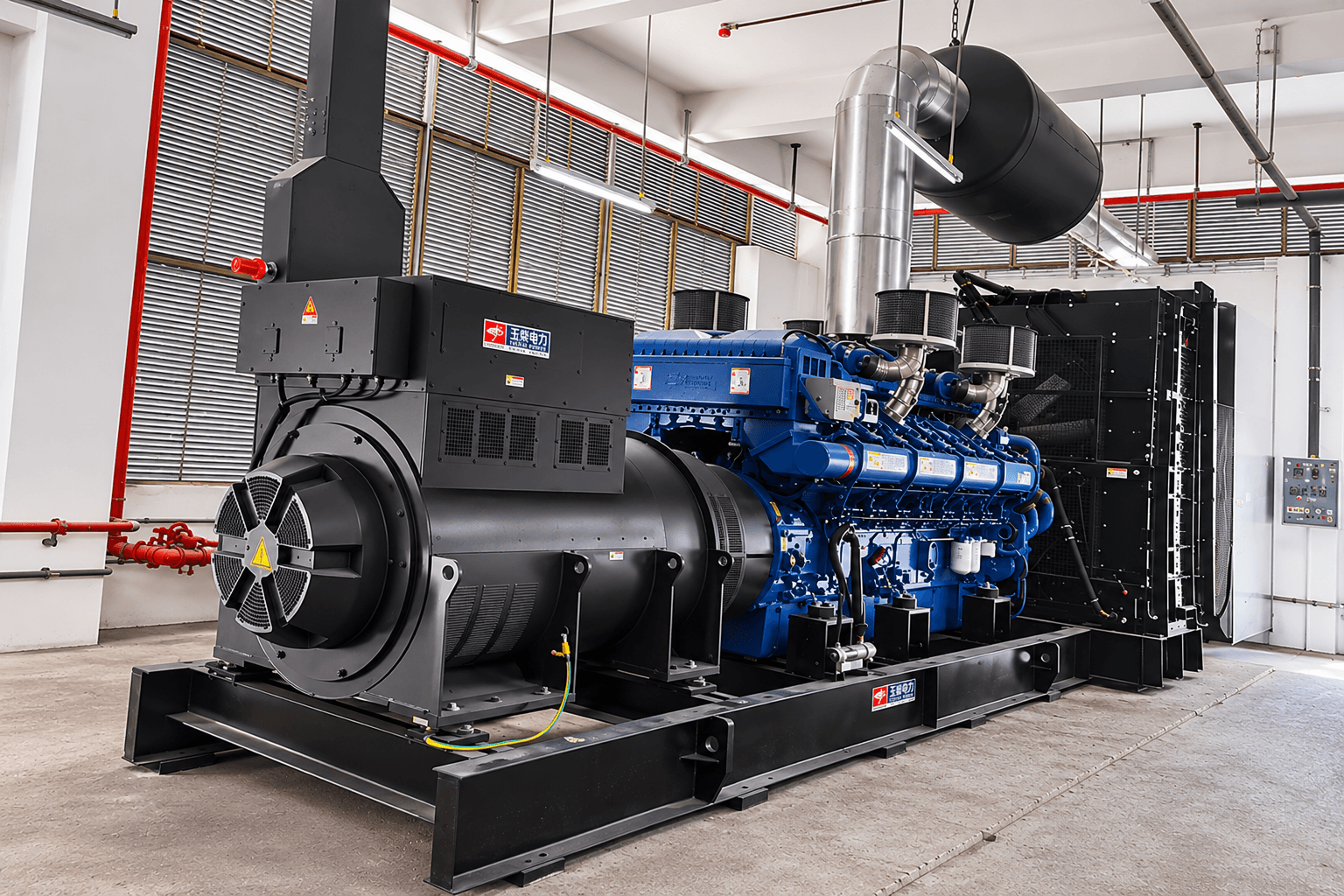
EvoTec 2,000 kW / 10.5 kV High-Voltage Generator Used in a Domestic Data Center Project
STAMFORD | AvK comprises alternator brands within Cummins Generator Technologies. Its portfolio serves industrial generation, critical standby power, and data centers. The manufacturer combines extensive product options with application engineering and an international authorized service network.
Core Advantages
l Broad capacity coverage: STAMFORD's published range extends from 7.5 to 5,000 kVA, while AvK products extend to 11,200 kVA across their respective portfolios.
l Different winding technologies: STAMFORD uses wire-wound designs, while AvK offers robust bar-wound configurations for larger and demanding applications.
l Data-center-relevant specifications: The STAMFORD P80 series lists a 380–13,800 V voltage range, 50/60 Hz operation, permanent magnet generator (PMG) excitation, and a DM110 AVR.
l Engineering and service support: The company provides data center application guidance and access to authorized parts and service dealers.
Best For: Large-scale and multi-site data centers seeking a broad range of alternator capacities, reliable critical backup power, and global service support.
Nidec Power provides alternator solutions through brands including Leroy-Somer and Kato Engineering. Its data center portfolio emphasizes engineered electrical performance, flexible configurations, and suitability for mission-critical infrastructure.
Core Advantages
l Dedicated product lineup: Published Leroy-Somer data-center series include LSA 52.3 at 1,860–2,750 kVA, LSA 53.2 at 2,000–4,300 kVA, and LSA 54.2 at 3,500–5,200 kVA.
l Electrical performance: The Data Center Pro offering highlights low subtransient reactance and high power factor capabilities, both relevant to system-level electrical analysis.
l Configuration flexibility: Nidec identifies solutions spanning 380–15,000 V and 1,500–1,800 rpm across its data-center platforms.
l Engineering customization: The company describes sizing assistance and adaptations for challenging temperatures and other operating conditions.
Best For: Data centers with complex electrical loads, demanding performance requirements, and projects requiring customized alternator configurations.
Mecc Alte manufactures alternators for industrial power generation, standby systems, and other critical applications. Its data center offering emphasizes voltage regulation, excitation technology, electrical performance, and maintainability.
Core Advantages
l Digital voltage regulation: Its DSR/DER regulators provide adjustable settings and operational fault-logging capabilities.
l MAUX excitation system: The manufacturer states that its auxiliary-winding excitation arrangement can support short-circuit current exceeding 300% of rated current under applicable conditions.
l Documented voltage accuracy: Mecc Alte specifies ±0.5% steady-state voltage accuracy with its DER regulator under stated operating conditions.
l Maintenance-focused construction: Accessible components, flexible winding arrangements, and optional protection configurations support different installation requirements.
Best For: UPS-intensive data centers prioritizing precise voltage regulation, nonlinear load compatibility, and convenient maintenance.
ABB is an international electrical engineering and automation company offering generators for industrial and critical-power applications. Its critical power generator portfolio includes the NMG series developed for demanding applications such as data centers.
Core Advantages
l Published electrical ratings: ABB lists 1,375–3,000 kVA rated output, 10.5–11 kV voltage, 50 Hz frequency, and 1,500 rpm rated speed.
l Compact construction: The design integrates the exciter, PMG, AVR, and terminal boxes to simplify installation and reduce required space.
l Specialized operating ratings: ABB states that its NMG generators with the specified CDCp rating support unlimited runtime and 110% overload capability under the applicable rating conditions.
l Durable winding construction: Form-wound windings and vacuum pressure impregnation are used to improve resistance to operational stresses.
Best For: Medium- and high-voltage data centers requiring compact generator designs, high power density, and specialized continuous-operation capabilities.
Selecting an alternator requires more than comparing nominal capacity. Procurement teams should evaluate technical compatibility, operating requirements, and lifecycle support.
Determine the facility's critical load, planned expansion, redundancy arrangement, power factor, and distribution voltage. Compare alternator kVA ratings with generator-set kW requirements and verify available capacity under the specified site conditions.
Review AVR specifications, excitation arrangements, subtransient reactance, harmonic performance, and load-step response. Request technical documentation demonstrating compatibility with the UPS system and expected electrical load characteristics.
Evaluate efficiency data, cooling methods, insulation class, temperature rise, protection ratings, and relevant testing procedures. Avoid assuming that one manufacturer is more reliable solely because of its quoted efficiency or rated capacity.
Verify compatibility with the selected engine, coupling arrangement, controls, protection system, and parallel generator configuration. Request project-specific drawings and confirm whether modifications require additional engineering validation.
Examine documented project references, available certificates, factory testing capabilities, and support arrangements. For international installations, confirm the availability of spare parts, qualified technicians, and response procedures in the target region.
Compare purchase cost alongside maintenance requirements, electrical losses, accessibility, spare parts, and expected service life. A lower initial price may not represent the lowest lifecycle cost if maintenance or integration requirements are substantially different.
A data center generator typically refers to a complete generator set containing an engine, alternator, controls, and supporting systems. The alternator is the component that converts mechanical shaft power into electrical power.
A suitable alternator should meet the required kVA rating, voltage, frequency, voltage regulation, and load-response specifications. It should also be compatible with the facility's UPS systems, electrical protection, and generator redundancy design.
Voltage regulation helps maintain controlled electrical output during changing loads. Effective AVR and excitation performance support power quality and improves compatibility with UPS systems, protection devices, and other connected equipment.
High-voltage alternators can be advantageous when a facility uses medium- or high-voltage distribution, potentially reducing current at a given power level. However, suitability depends on infrastructure design, equipment ratings, protection coordination, and overall project economics.
Selecting reliable alternator manufacturers for data center generators requires evaluating voltage regulation, capacity, electrical performance, and technical support.
EvoTec Power offers high-voltage alternators and documented data center project experience for consideration. Generator-set manufacturers, contractors, and developers can contact EvoTec's engineering team to discuss project-specific requirements.