
Data centers need backup power that can take over quickly, remain stable under demanding loads, and continue operating when utility service is unavailable. The IEA reports that global data-center electricity demand reached about 485 TWh in 2025 and is projected to rise to roughly 950 TWh by 2030. Diesel has long been the standard fuel for mission-critical standby generation, but natural gas is receiving more attention as operators weigh fuel logistics, emissions, operating costs, and longer-duration use. The better choice depends on electrical performance, fuel resilience, permitting, runtime expectations, and the design of the wider backup-power system.
A data-center backup system works as a coordinated chain rather than as a generator acting alone. When utility power fails, the UPS keeps critical IT loads supplied while the standby generator starts, reaches acceptable voltage and frequency, and connects through transfer and switchgear systems. The generator then carries the required load until utility power returns or another source takes over. The U.S. Department of Energy similarly describes standby generators and automatic transfer switches as coordinated components for maintaining critical loads during a utility outage.
That sequence puts tougher demands on a data center generator than on an ordinary standby unit.
l Fast and Reliable Startup: Backup generators must start and accept the required load quickly enough to work within the facility's UPS ride-through and power-transfer strategy.
l Voltage and Frequency Stability: Consistent electrical output prevents sensitive IT equipment from tripping or sustaining damage.
l Transient Response and Load Acceptance: Alternators and engines must handle specified step loads while keeping voltage and frequency recovery within the project's design limits.
l Nonlinear Load Support: Backup systems must withstand harmonic distortion caused by UPS rectifiers, variable speed drives, and server power supplies.
l Extended Continuous Operation: Facilities need sufficient generator runtime to support their planned outage and resilience scenarios.
l Parallel System Reliability: Large data centers often use multiple generator sets, making reliable synchronization, load sharing, and parallel operation important.
EvoTec Power highlights similar priorities for data centers: high voltage, high efficiency, high reliability, reliable insulation, strong nonlinear-load capability, and stable parallel or grid-connected operation. These characteristics matter whether the generator set runs on diesel or natural gas.
When comparing diesel vs natural gas generators, operators should assess complete generator-set designs, local fuel infrastructure, outage scenarios, emissions rules, and expected duty cycle. Modern natural gas generators can be viable for data centers in suitable projects, but site conditions and performance requirements must support the choice.
|
Feature |
Diesel Generators |
Natural Gas Generators |
|
Startup & Load Acceptance |
Well-established fast-start and strong transient performance for standby applications. |
Performance varies by genset design; modern fast-response systems can support demanding standby applications. |
|
Fuel Supply Resilience |
On-site fuel storage provides greater control over backup reserves during grid outages. |
Continuous pipeline supply; vulnerable to seismic events or gas pressure drops. |
|
Runtime & Fuel Storage |
Runtime depends on on-site fuel capacity and the availability of replenishment during prolonged outages. |
Can support extended operation without on-site liquid-fuel refueling when adequate pipeline service remains available. |
|
Emissions Profile |
Typically higher PM emissions; emissions-control requirements depend on engine design and local regulations. |
Lower carbon intensity, lower PM, and reduced local air pollution. |
|
Maintenance Needs |
Requires fuel polishing, regular fluid checks, and wet-stacking prevention. |
Fewer fuel degradation issues; lower ongoing fuel management labor. |
Diesel generators are widely used for their fast startup and strong transient performance. However, actual response depends on the specific genset and power architecture. Modern fast-response natural gas generators have narrowed the performance gap, so data centers should compare startup time, load acceptance, and voltage and frequency recovery based on the selected generator set rather than fuel type alone.
Diesel systems store fuel on-site, giving operators direct control over backup reserves. However, extended outages may still require fuel deliveries and ongoing fuel-quality management. Natural gas avoids on-site liquid-fuel storage and refueling, but depends on external pipeline infrastructure, so supply continuity and local utility resilience should be evaluated as part of the backup-power plan.
Natural gas generators eliminate fuel stability management, such as fuel polishing or biocide treatment required for stored diesel. During extended power outages, natural gas units can operate without on-site refueling as long as adequate pipeline capacity and supply remain available.
Natural gas generators for data centers generally produce lower particulate emissions than conventional diesel units, while NOx performance depends on engine design and emissions controls. In some regions, this may offer permitting advantages. Diesel generators may require additional emissions-control technologies depending on engine rating, operating classification, and local regulations.
Diesel installations require dedicated fuel containment systems, leak detection, and routine fuel quality testing to prevent microbial growth. Natural gas systems reduce liquid-fuel maintenance but require adequately sized gas piping, appropriate pressure regulation, safety shut-off systems, and compliance with local gas codes.
Selecting the right data center backup generator depends on site risk factors, regional regulations, and infrastructure availability.
Diesel systems remain the preferred choice under specific site conditions:
l Off-Grid Independence: The facility requires guaranteed fuel security on-site without dependence on municipal gas pipelines.
l Infrastructure Limits: Local natural gas pipelines lack sufficient flow capacity or pressure to feed multi-megawatt generator banks.
l Fast Load Demands: The electrical architecture requires rapid generator startup and load acceptance within the available UPS ride-through window.
l Permitting Flexibility: Local environmental regulations permit standard diesel storage and periodic testing schedules.
Natural gas systems provide strategic advantages in alternative operational settings:
l Pipeline Availability: The facility sits adjacent to reliable, high-volume natural gas supply lines.
l Site Constraints: On-site environmental permits restrict large diesel fuel storage tanks due to soil or water protection zones.
l Strict Emissions Standards: The data center operates in non-attainment air quality zones with strict limits on diesel exhaust particles.
l Extended Run Requirements: The operator anticipates frequent, long-duration power outages where liquid fuel replenishment is impractical.
Modern facility designers increasingly deploy hybrid architectures to maximize uptime. Combining natural gas or diesel generators with battery energy storage systems (BESS) or microgrid controls can reduce generator cycling and potentially lower fuel consumption, depending on how the system is operated. BESS can provide short-duration ride-through or help manage rapid load changes while generator sets start and accept load.
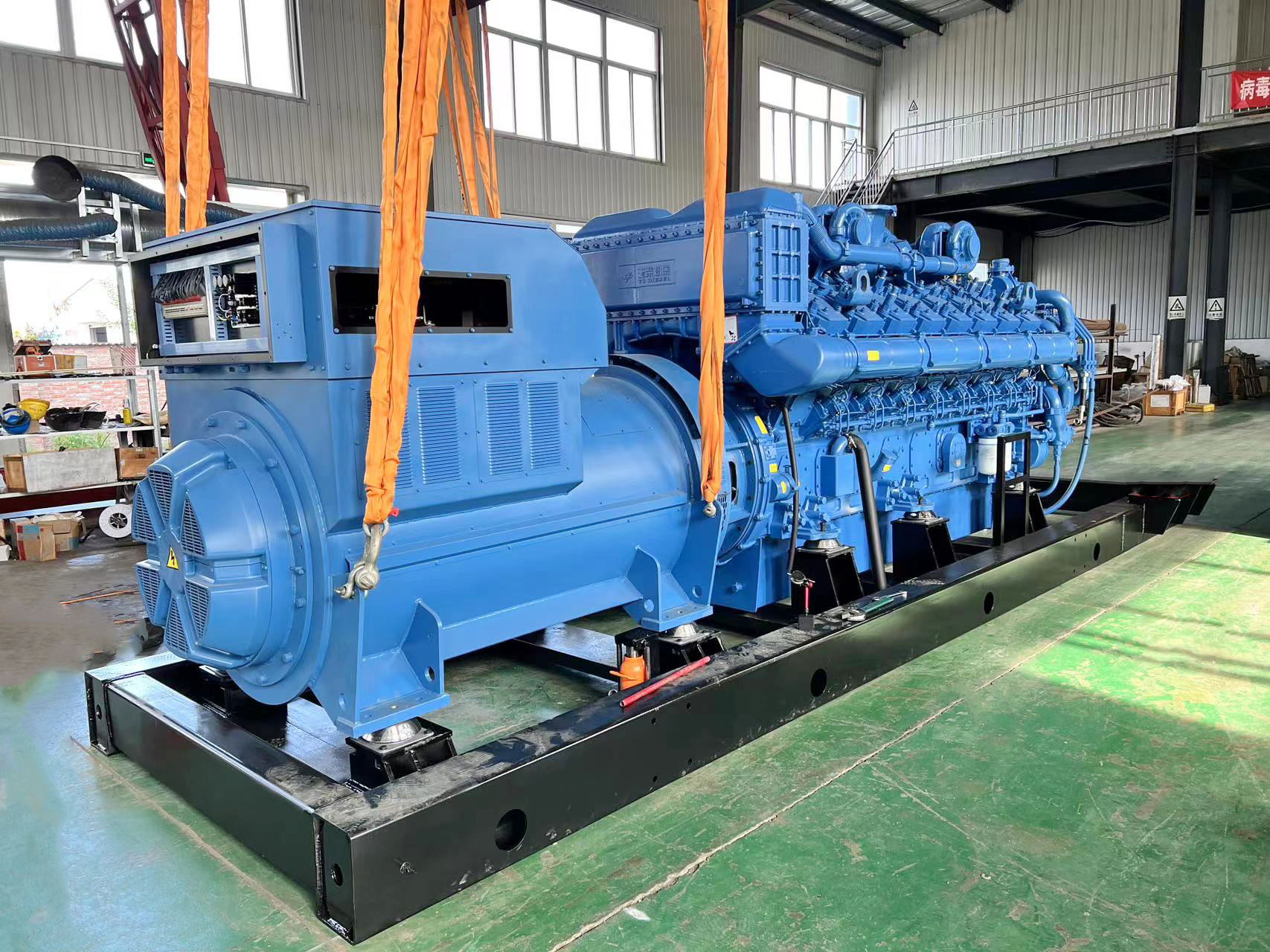
Evaluating generators for data centers involves more than selecting the engine fuel source. While the engine burns fuel to create mechanical torque, the alternator converts that mechanical energy into stable electrical power. A high-performing engine cannot protect server racks if the alternator fails to manage voltage spikes or heavy harmonic distortion.
For data center backup generators, key alternator characteristics focus on power stability, load adaptability, and system synergy. The alternator must maintain strict voltage and frequency stability during load swings, deliver high efficiency with low temperature rise, and easily support complex nonlinear loads like UPS systems. Fast dynamic performance and seamless parallel or grid-connected operation are also essential for reliable multi-megawatt backup power.
EvoTec Power designs and manufactures synchronous alternators for industrial, high-voltage, marine, and customized applications. Its data-center guidance emphasizes high-voltage output, reliable insulation, high efficiency, nonlinear-load capability, and stable parallel and grid-connected performance.
l High-Voltage Capability: EvoTec manufactures alternators supporting high-voltage configurations (such as 10.5 kV) suited for multi-megawatt data centers, reducing busbar current and transmission line losses.
l Enhanced Efficiency: EvoTec alternators deliver power-generation efficiency 0.5%–1% higher than peer products, together with lower temperature rise and improved dynamic performance according to published data-center information.
l Nonlinear Load and 0.9 Leading Power Factor Support: EvoTec states that its alternators can operate stably at a 0.9 leading power factor while providing strong nonlinear-load capability and good compatibility with different power systems.
l Multi-Megawatt Project Experience: EvoTec lists several high-capacity data-center deployments, including the Ordos Big Data Center, Yan'an Cloud Computing Data Center, and Hunan Data Cloud Project.
It is worth mentioning that EvoTec Power will participate in Data Centre World Asia 2026 on September 29–30 at Marina Bay Sands, Singapore. Visitors can meet the EvoTec team at Stand Z45 to learn more about its alternator solutions for data center power applications and discuss high-voltage, high-capacity, and customized project requirements.
No single answer fits every data center. Diesel offers controllable on-site fuel and a long history in fast-response standby service. At the same time, natural gas can reduce liquid-fuel storage needs and may suit projects expecting longer runtimes with dependable pipeline infrastructure.
Whichever fuel is selected, dependable electrical output remains essential. Contact EvoTec Power to discuss your project needs and identify an appropriate alternator configuration for your data-center backup power system.