
Reliable power is the backbone of telecom infrastructure. As networks push into rural areas and 5G densifies urban grids, the telecom generator market is expanding fast. According to a report by Global Market Insights, revenue in the global telecom generator market is forecast to grow from roughly USD 1.7 billion in 2024 to USD 2.5 billion by 2034 at a 6.5% CAGR.
For wholesalers, sourcing the right telecom generators for industry applications is now a competitive edge. Therefore, this guide helps generator wholesalers compare generators for telecom industry applications and choose products that support long-term value.
Generator wholesalers often serve different telecom scenarios: remote towers, urban rooftop sites, temporary mobile stations, and hybrid energy systems. Understanding the main types of telecom generators helps in selecting the right solution for each application.
|
|
Diesel Generators |
Gasoline Generators |
DC Generators |
|
Key Features |
Engine-driven, uses diesel fuel, supports high load capacity |
Portable, simple structure, uses gasoline fuel |
Direct DC output (commonly -48V), integrates with battery systems |
|
Advantages |
Durable, reliable, suitable for long-term backup, stable fuel storage |
Easy to deploy, flexible, suitable for temporary use |
High efficiency, reduced conversion loss, compact design |
|
Limitations |
Higher maintenance complexity, requires proper load sizing |
Fuel is volatile, not suitable for long-term storage |
May require system integration planning |
|
Typical Applications |
Remote towers, disaster recovery, unstable-grid areas |
Emergency repair, mobile base stations, short-term power |
Hybrid systems, off-grid telecom sites, energy-saving networks |
In summary, diesel generators remain the primary choice for long-term telecom backup due to their reliability and fuel stability. Gasoline generators are better suited for temporary or portable applications, while DC generators are increasingly favored in modern telecom systems for their efficiency and compatibility with hybrid energy solutions.
Choosing generators for telecom industry applications is not only about rated power. Wholesalers should evaluate reliability, efficiency, installation conditions, operating cost, and compatibility with telecom control systems.
l Reliability and Durability:
A generator failure may lead to network downtime, customer complaints, and service loss. Therefore, reliability should be the first priority.
For remote areas and weak-grid regions, wholesalers should recommend products designed for long runtime and stable operation. For sites with frequent outages, prime-rated solutions may be more suitable than standby-rated units.
l Fuel Efficiency and Long-Term Operating Cost:
Wholesalers should consider fuel consumption at real operating load, not only at full load. A generator is often most efficient under a suitable load range.
For 5G macro sites, power demand can be much higher than at older 2G or 3G sites due to large-scale antennas, baseband processing, and cooling systems. Proper capacity planning helps avoid both overload and inefficient low-load operation.
l Compact Design and Easy Installation:
Telecom sites often have limited space. Equipment may need to be installed in cabinets, shelters, rooftops, tower compounds, or containerized systems. A compact generator design can reduce footprint and make transportation easier.
l Low Noise and Emissions Compliance:
Telecom power systems are not only used in remote areas. Many base stations are installed near residential buildings, commercial areas, or urban roads.
Silent canopies, improved ventilation design, and proper exhaust treatment can help meet project requirements. Emissions compliance also matters.
l Maintenance Intervals and Service Accessibility:
Telecom operators often manage hundreds or thousands of sites. If a generator needs frequent on-site service, operating costs will increase quickly. Easy access to filters, cooling systems, wiring, and control modules can reduce maintenance time.
l ATS and Remote Monitoring Compatibility:
Automatic transfer switches (ATS) enable unattended switchover, while remote monitoring — tracking fuel level, battery voltage, oil pressure, temperature, runtime, and fault codes — lets operators manage large tower networks with fewer site visits and more predictive maintenance.
The alternator is the core component that converts mechanical energy into electrical power. In telecom generators, alternator quality directly affects voltage stability, power quality, equipment protection, and generator lifespan.
Telecom equipment is sensitive to unstable power. Poor voltage regulation, excessive harmonic distortion, or weak dynamic performance may affect rectifiers, batteries, cooling systems, and communication devices.
High-quality alternators help maintain stable output during sudden load changes. They also improve efficiency. Better electromagnetic design, ventilation, insulation, and temperature control help reduce energy loss and extend service life. This means fewer after-sales problems and stronger product competitiveness.
Evotec Power short-shaft generators are designed for compact generator set integration and telecom-related power applications. Key features include:
l Wide power range: The EVO-TD short-shaft generator series covers 6.4–40kW, 45–80kW, 90–128kW, 132–200kW, and up to 200–400kW options, supporting small base stations, medium telecom sites, and larger power-demand applications.
l Compact structure: The body length is more than 100mm shorter than comparable products, helping generator set manufacturers build more compact gensets. This is especially valuable for telecom shelters, equipment rooms, and space-limited tower sites.
l Efficient cooling design: The generators are designed with strong ventilation and heat dissipation performance. This helps maintain stable operation in high-temperature or enclosed environments, extending machine life and reducing the risk of failure.
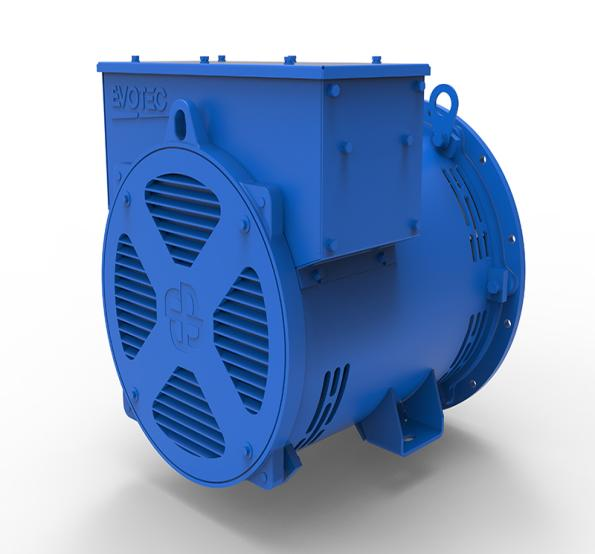
EVO-TD45~80kW Short-Shaft Generator
Purchasing telecom generators from a reliable distributor is crucial for telecommunications applications. Evotec Power provides alternator and generator solutions for demanding power applications. For generator wholesalers, its value can be clearly understood through the following key points:
l Strong R&D and manufacturing capability: The company emphasizes a "no copy" original-design philosophy; it holds more than 70 innovation patents, operates a large generator R&D center in China, and has a 90,000-square-meter modern workshop with an annual production capacity of 30,000 units.
l Verified quality: EvoTec alternators comply with IEC 60034-1 standards and are certified to ISO 9001/14001/45001, CE, and multiple classification-society approvals and honors(including RS and CCS).
l Stable electrical performance: Evotec Power generators offer strong electrical performance indicators, including TIF ≤50, THF ≤2%, and THD ≤3%.
l Environmental durability: Evotec Power generators are designed for harsh environments. The enclosure protection level can reach up to IP57, and products can be treated for moisture, mildew, and salt-fog resistance.
l Low noise performance: Evotec Power solutions are described as having noise levels 5–10dB lower than national standards, helping meet project requirements in noise-sensitive environments.
l Proven application experience: Generators already powering China Mobile and China Unicom base station projects, plus bulk telecom exports to the Middle East and Southeast Asia.
As the telecom generator market continues to expand alongside 5G rollout and rural connectivity programs, wholesalers that can offer compact, power-quality-focused, field-proven solutions will be best positioned to win telecom accounts.
Evotec Power's generators give wholesalers a product line built specifically for that opportunity — contact Evotec Power for reliable telecom generators for your business.
